Sketch to Lino Process, part 1

Working out all the details of the composition at the draft stage is quite crucial before moving on to carving the lino. In this part, I will walk you through my approach and in the second part show how I transfer the refined draft on to a lino block.

Some artists prefer more of an expressive approach and can start carving based on a very rough sketch. Some prefer to draw directly on a lino block. I found that resolving all the details of the composition beforehand on paper is quite helpful and will illuminate any miss steps down the road. I prefer to develop the draft in pencil or on a tablet so that it looks very close to the final linocut. There will still be quite a lot of things to improvise on once you start carving, since carving is very different from drawing.

Here is an example of a flower sketch that I’d like to turn into a linocut, including some initial reference photos.
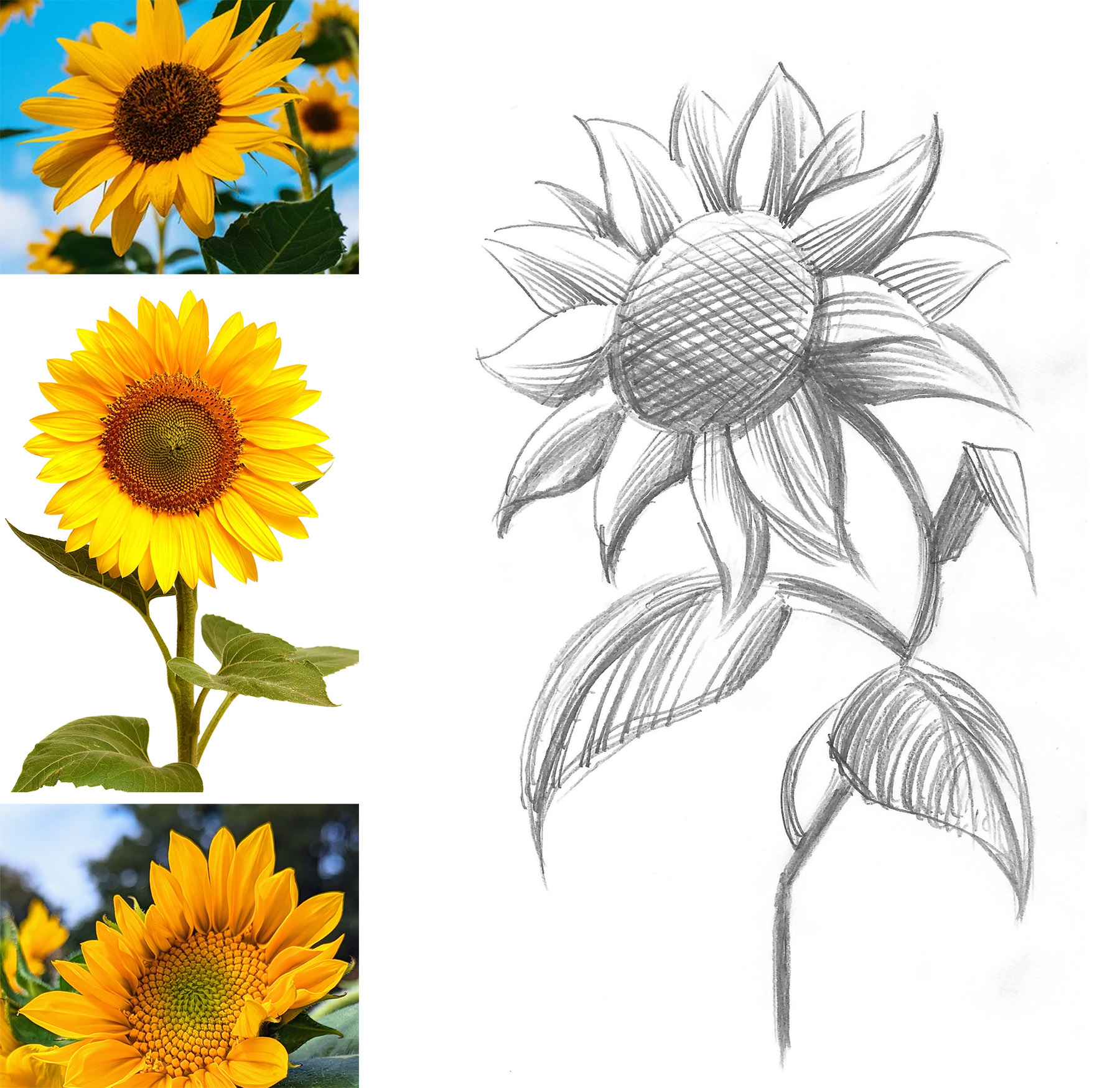
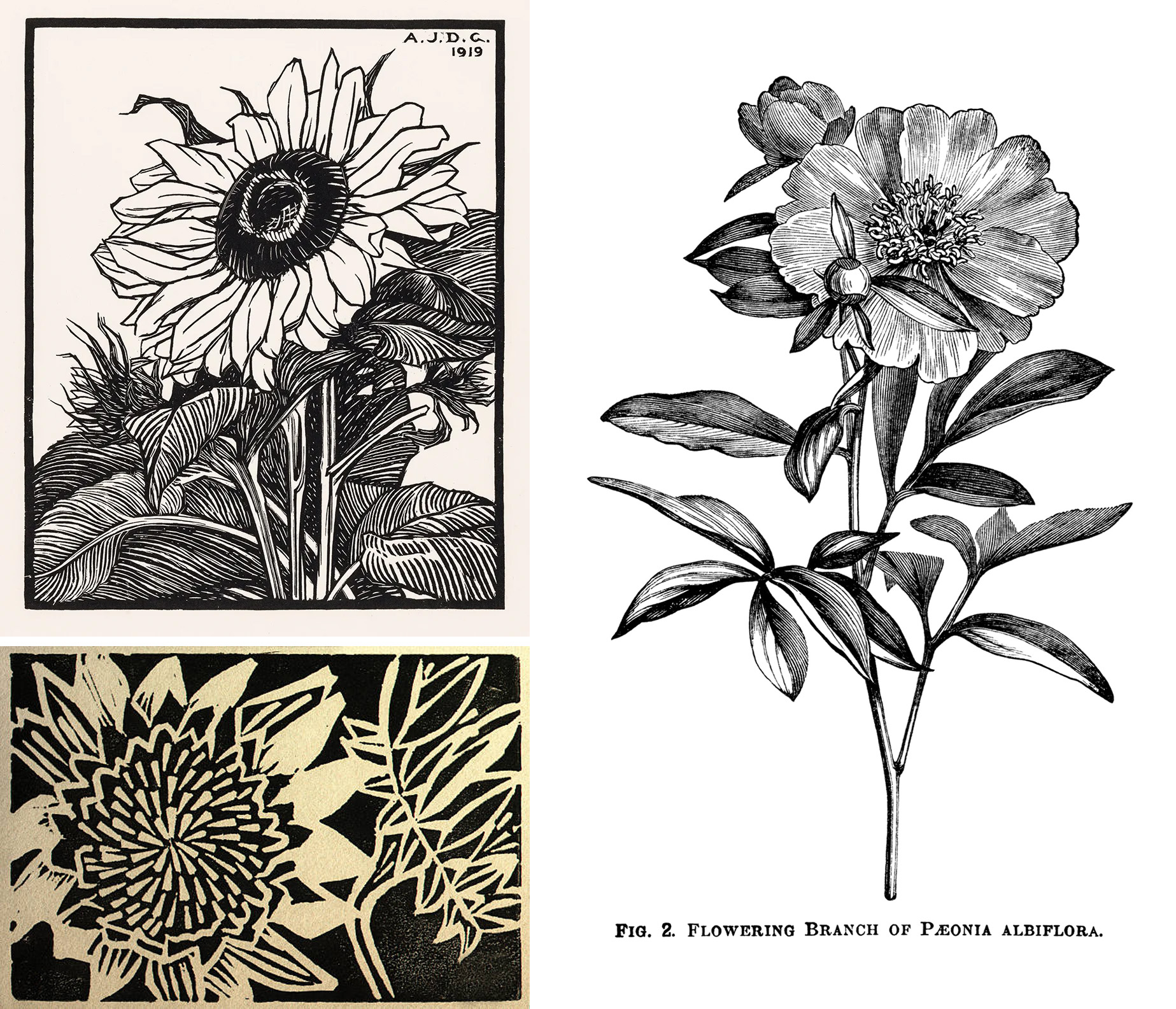
This is just an idea and it doesn’t really give me much clues on how to approach the shading or the cross hatched parts, along with other elements of design. Remember that you can’t really create “greys” in a one color linocut, but you can create an illusion of greys and halftones. Relief printmaking has its own visual vocabulary which is different from drawing or painting. At this point it’s very helpful to do your research and get clues from how other printmakers were able to achieve the results that you are going for. When studying the reference images, it’s important not just to copy the technique, but see what additions you can make to create a more unique, personal look.

Here are just a few examples of classical plant prints (top left – a print by Julie deGraag, 1919; bottom left and right – artist unknown).
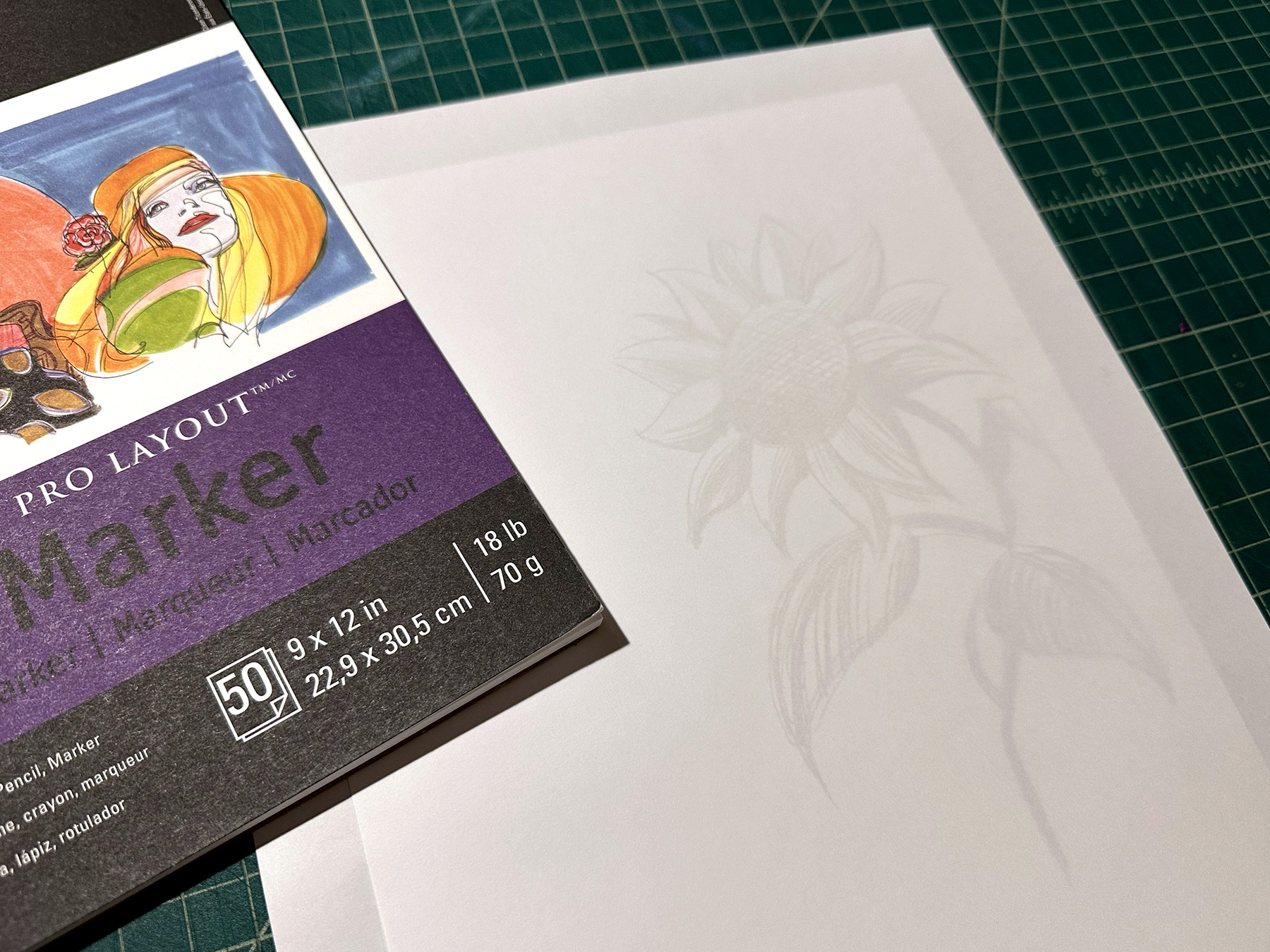
I lay the sketch under the marker paper and start to work out the details. You can see through the marker paper, so that’s really helpful, but it’s not as transparent as tracing paper. So, you can work on a new interpretation while still seeing the original sketch. You can also use regular print paper and a lightbox for this step.
Sometimes I rework the draft several times until everything is how I would like it to be. At this stage I am trying to eliminate the grey tones and just focus on solid black lines and shapes. After the final draft is complete (left image), I scan it and increase the contrast in Photoshop (right image). When the image will be transferred onto a lino block from a printout using CitraSolve solution, it’s important to eliminate all the greys, since they will not transfer – more on this in the next part.
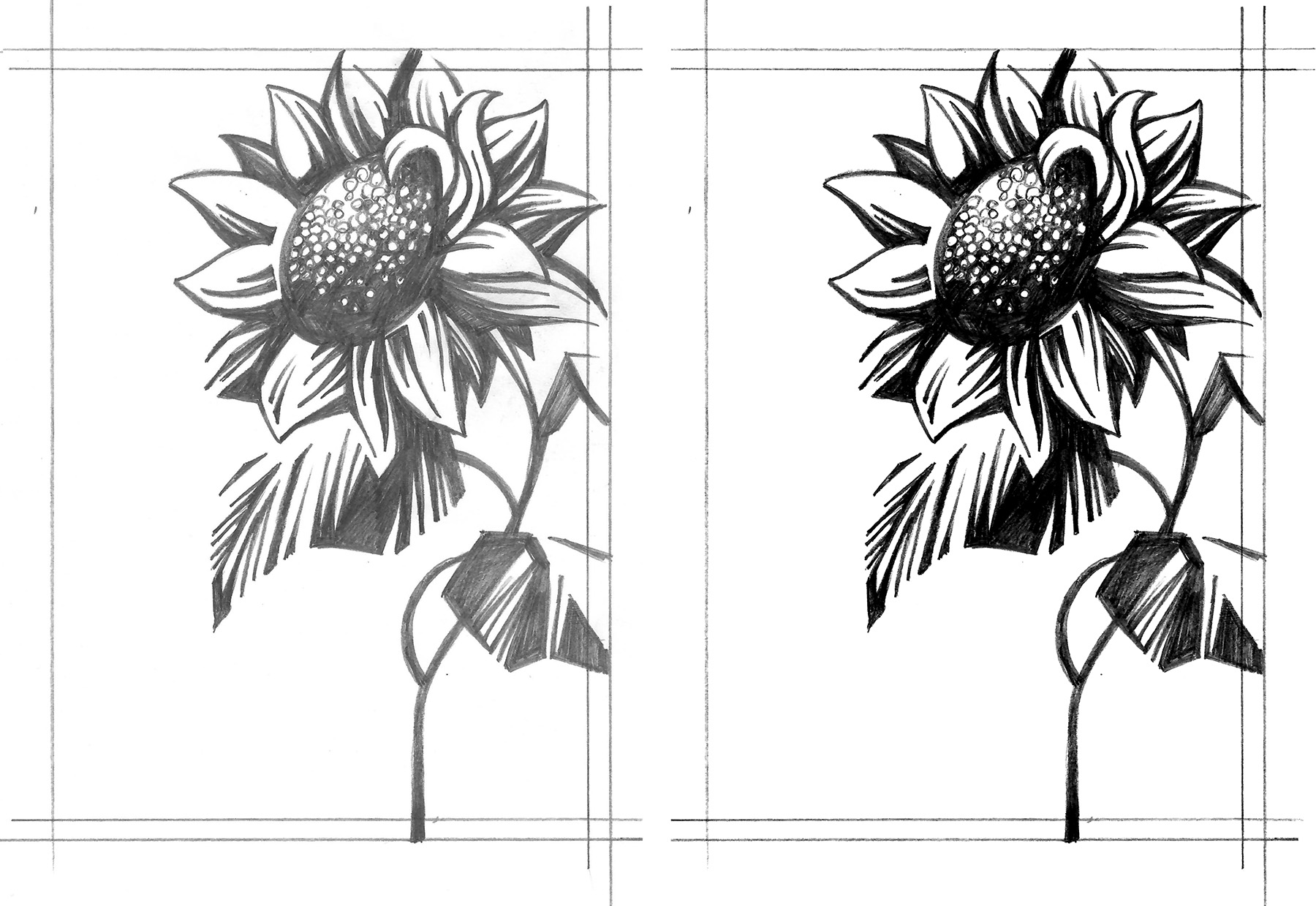
Once I have a solid black and white image, I am ready to transfer it to a plate.

When working on the multi-color print, I still like to start with the solid framework (one plate). Once that’s resolved, I will start to add additional layers that I want to be in color. This can be done on a marker paper or directly in Photoshop. Lately, I have been going over the final pencil drafts on a drawing monitor or iPad pro. It’s easy to create layers and try out different approaches. Below is an example of a sketch and refined draft created in Photoshop using an XP-Pen drawing tablet.
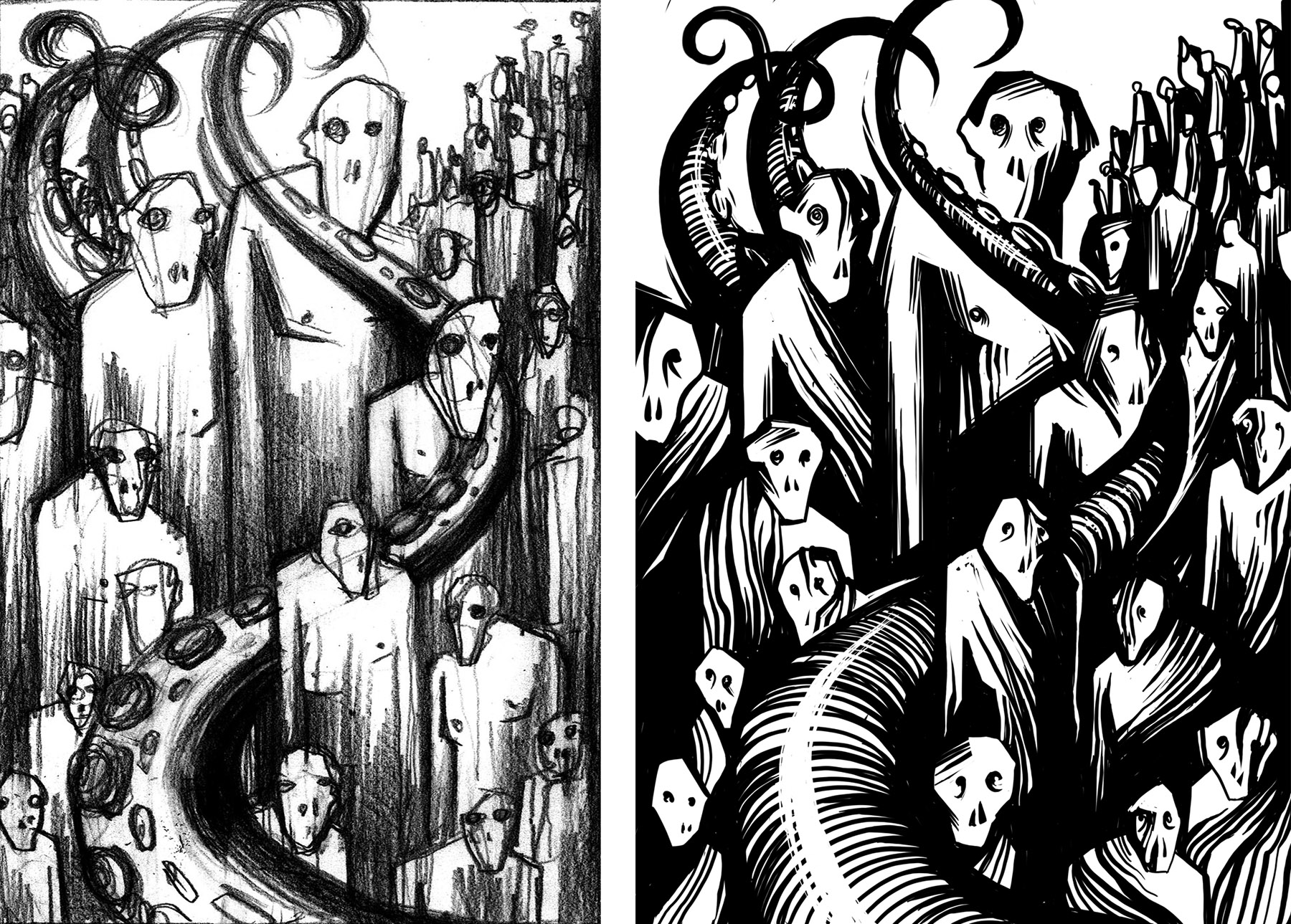
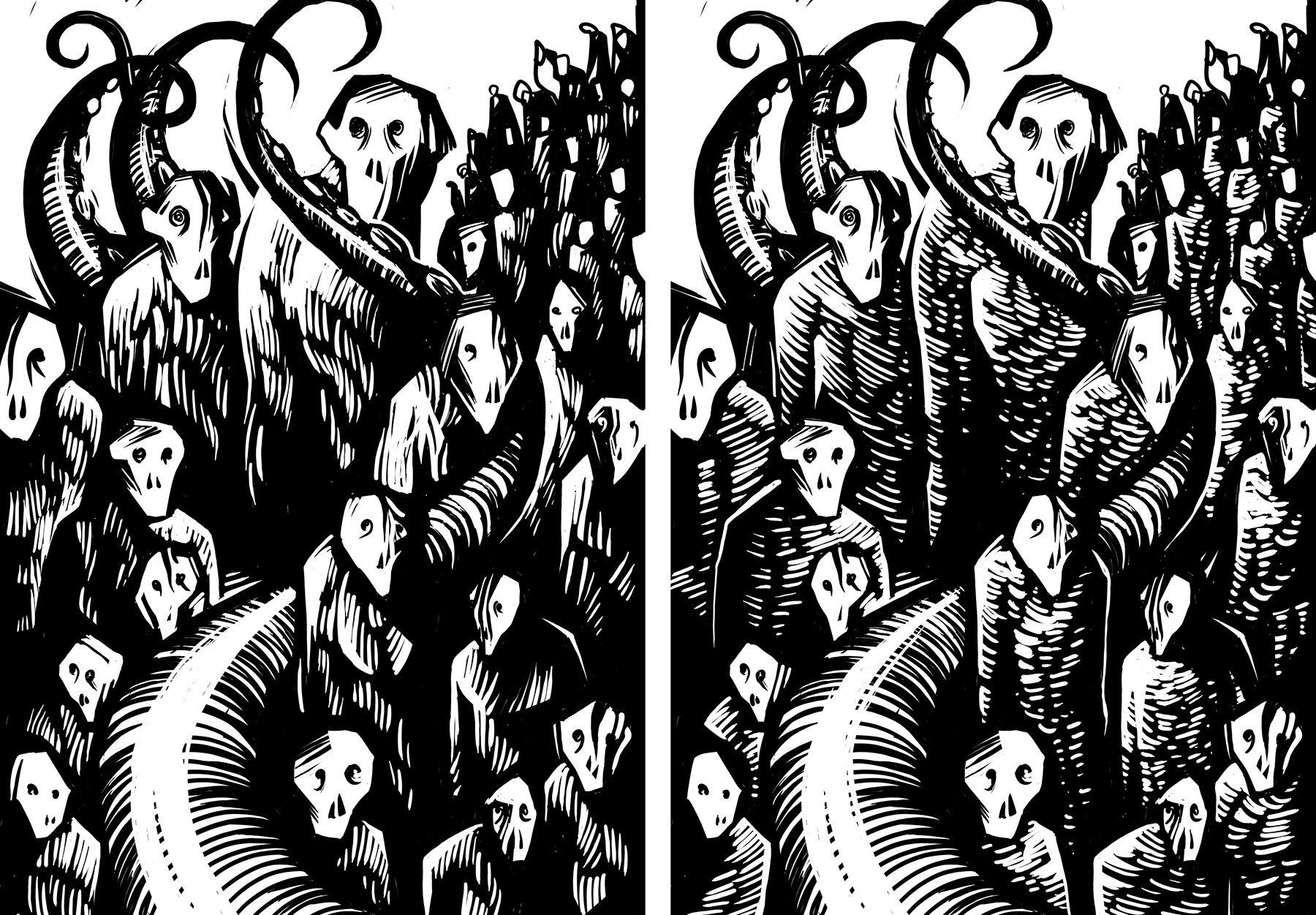
It’s important not to rush things. I usually let the printout of the draft hang in my studio for a few days. Oftentimes, I would make adjustments or add additional elements, while thinking about the final print and the limitations that I might encounter when carving. In the examples below I kept the composition the same, but tried out different textures on the characters to see what will give me the most dynamic composition. The version on the left was used for the final print.
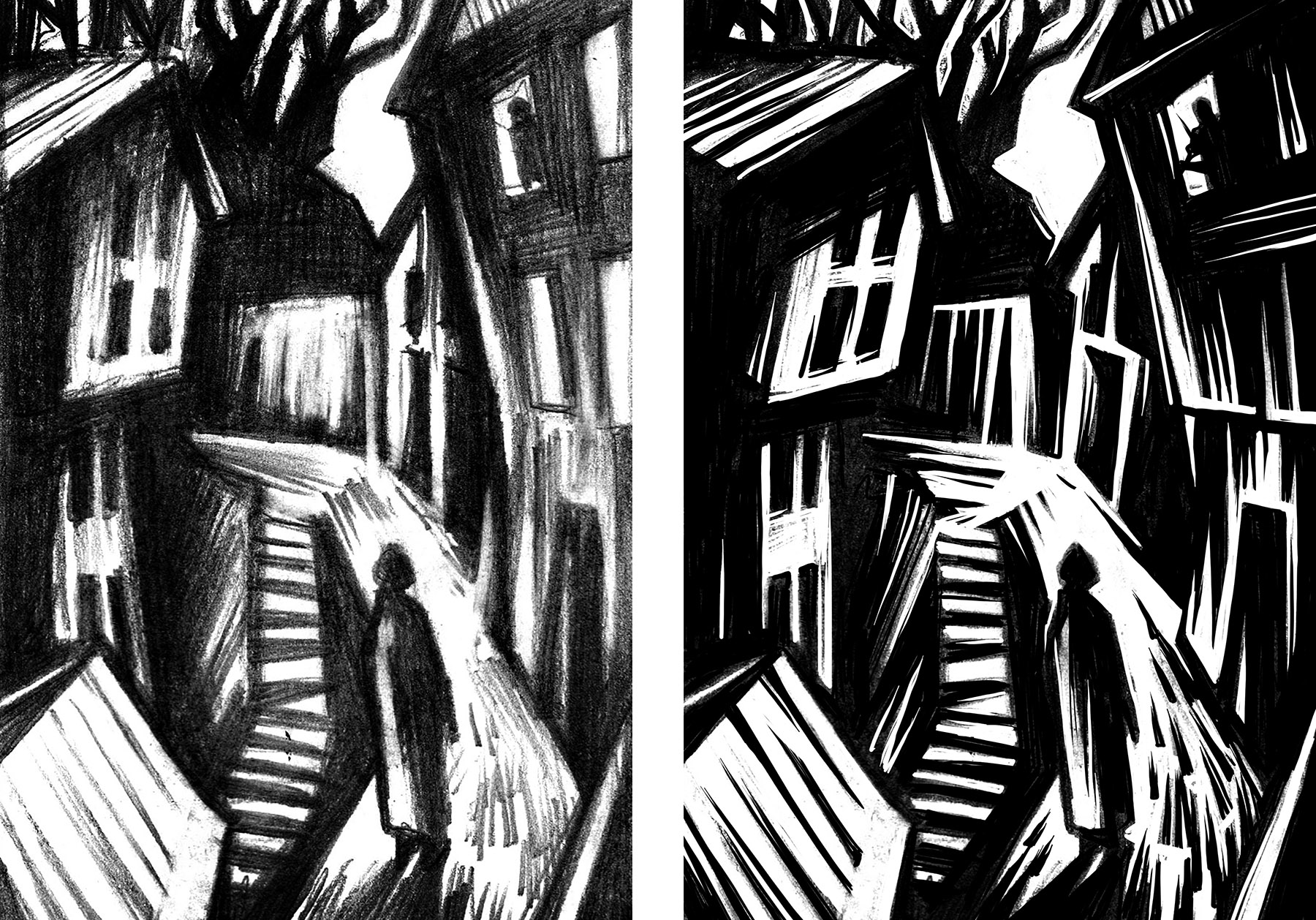
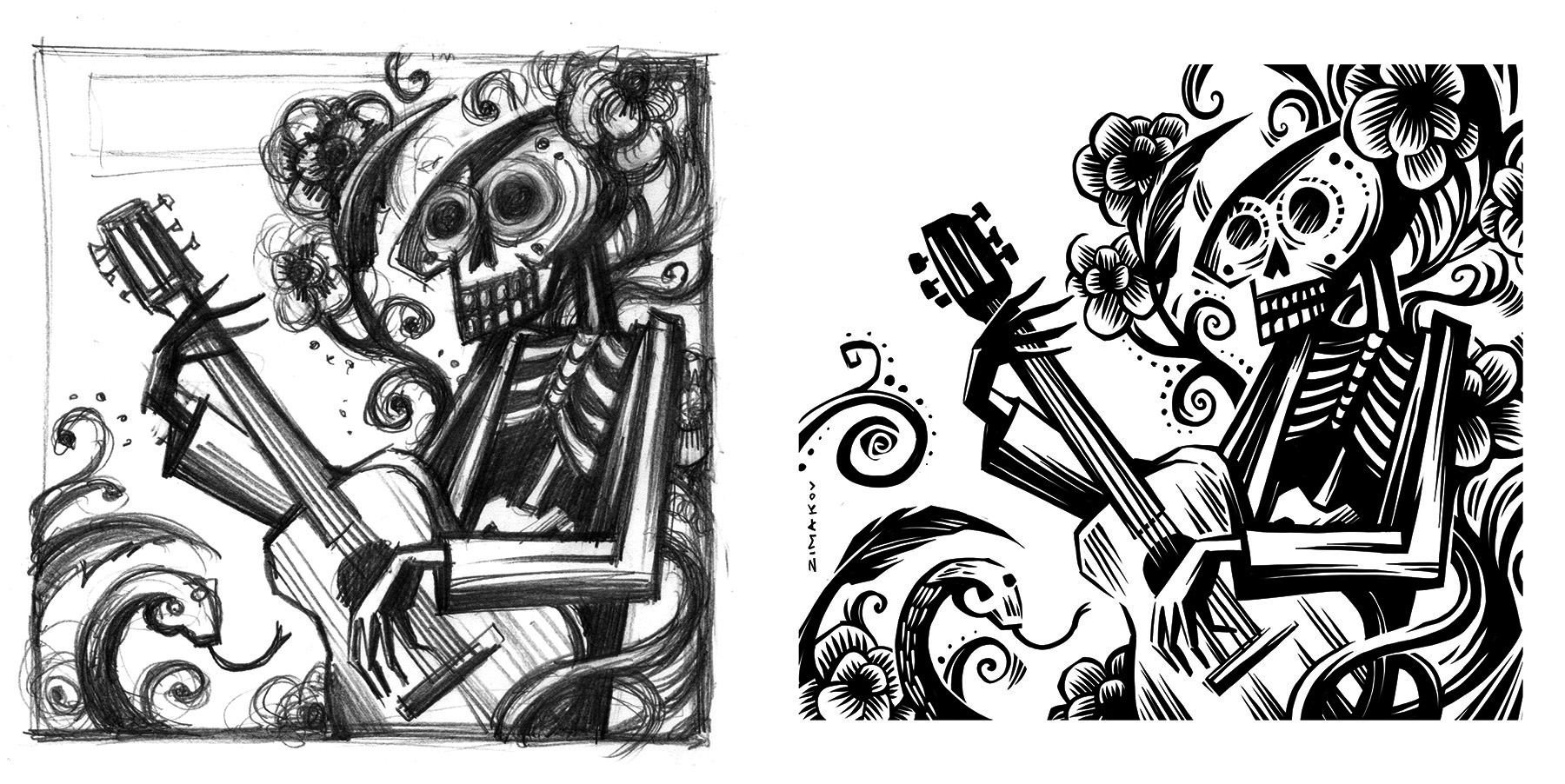
Here are a few more examples of initial sketches and the final draft ready for transferring to a linoplate.
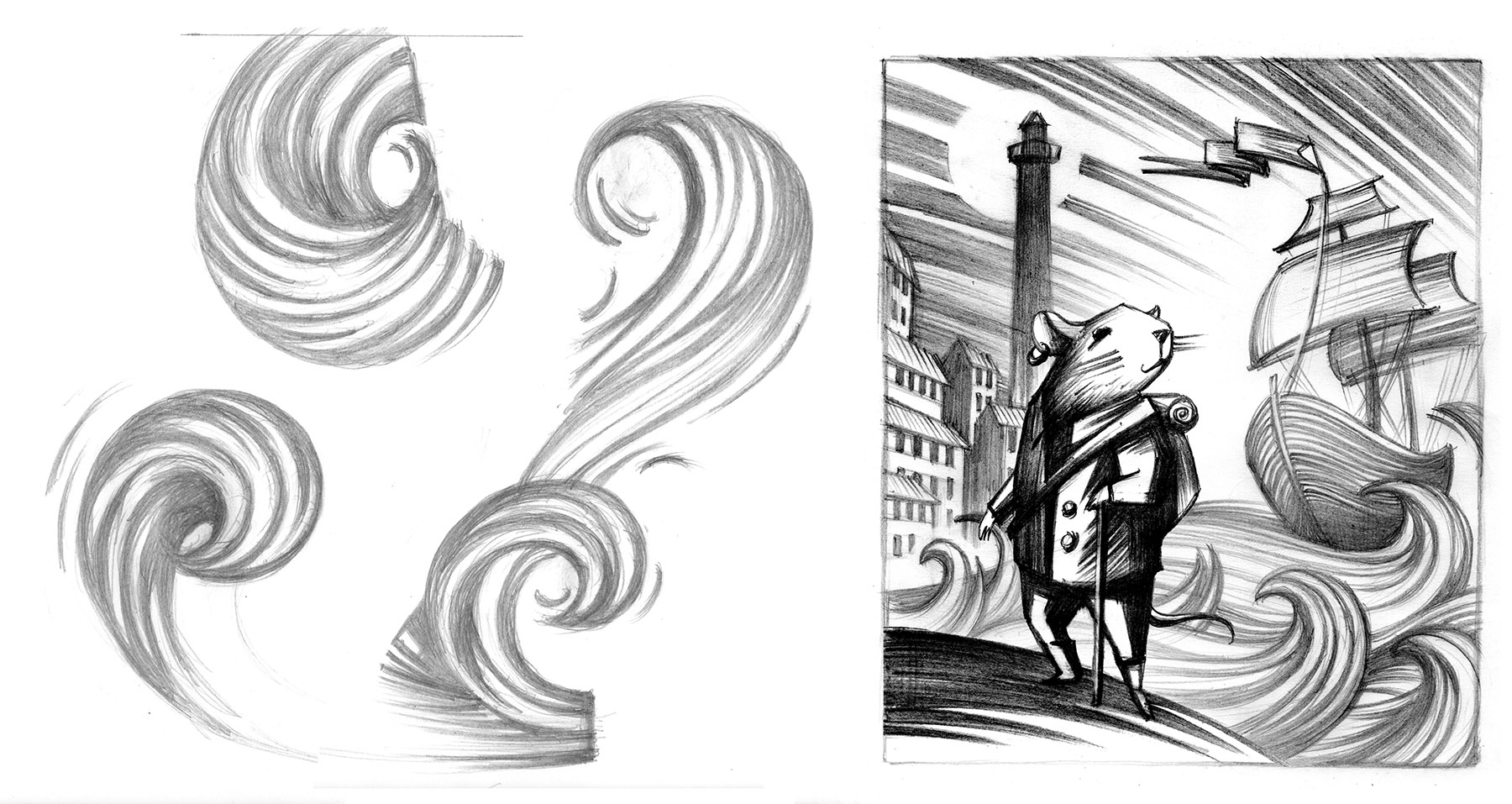
TIP: When working out an element that you haven’t done before in a print, it’s always good to practice various approaches to creating that element. Those are different interpretations of waves and how I applied them in a final composition.
The Call of Cthulhu in 3D

HP Lovecraft cover

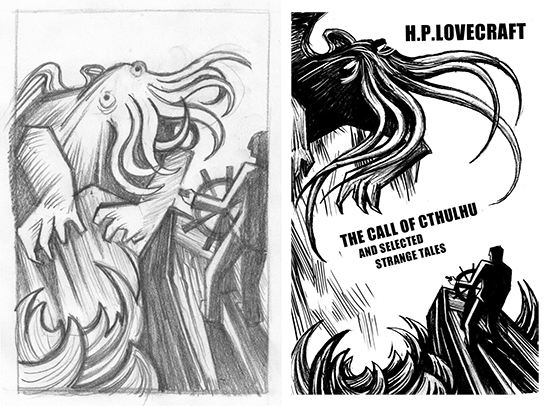
Back in 2010 I was approached by Matthew Broughton, a senior designer at Vintage, to do a cover for The Call of Cthulhu by the great H.P. Lovecraft. This was going to be one in a series of 5 classics that they were releasing that year that would feature a 3D cover. This was the really cool part! Each book would come with a pair of 3D glasses and obviously the cover needed to be dimensional. I was quite intrigued by this challenge and got down to work.

Zimakov Cthulhu sketch

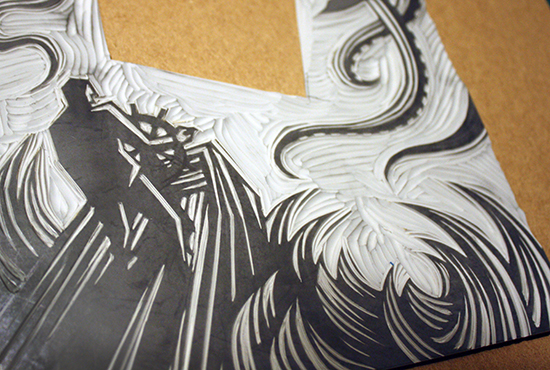
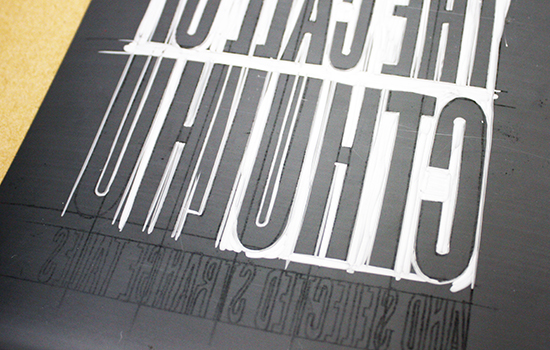
After brainstorming, a few pencil sketches and ink drafts, I moved forward with the lino. In addition to the image, we decided that the title should also be carved out.

HP Lovecraft Cthulhu

linocut title Call of Cthulhu

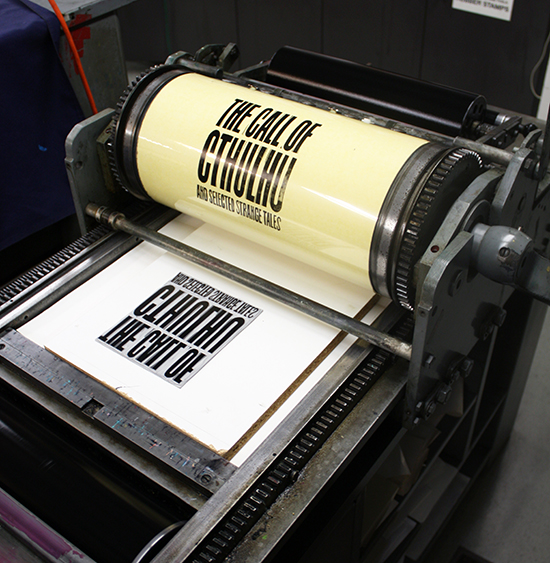
I usually print proofs and drafts on my little etching press in the studio, the final printing in this case was done at the Otis Lab Press on one of their Vandercooks.

Vandercook Zimakov

Once everything was printed, scanned and digitized, I skewed the type a bit to give it more of a dramatic look and make it fit with the image more. At this point the trick was to get the image working with the 3D glasses (final version on the right).

Call of Cthulhu printmaking linocut

After some internet research and looking through tutorials I reached out to my good friend Jim Campbell for some tips with this. Jim’s an expert. He collects antique photographs and gives them a 3D effect (some of this stuff can be seen here). Jim was quick to respond with some pointers.

3D tutorial

Then it was on to more Photoshop for me. I first broke down the image and title into many layers, depending on how close or far I wanted them to appear. Bellow are the two main separations, but there are quite a few little sub layers within them. Those were placed on top of one another using the Multiply blending mode (third image).

3D separation linocut

From that point on it was a matter of sitting in front of the screen for a few hours with the 3D glasses on and shifting layers left and right, up and down. Don’t want to get too technical here. The main trick is this: the more the red and cyan layers are off-register, the closer that part will appear to the viewer, the more they are in line with each other – the farther the image will be.

Cthulhu Zimakov

If you get your 3D glasses out you can see the effect, however your monitor colors might be off. So the best thing to do is get the book and see it in person. The 3D glasses come with it!

Amanda Palmer – The Alchemist

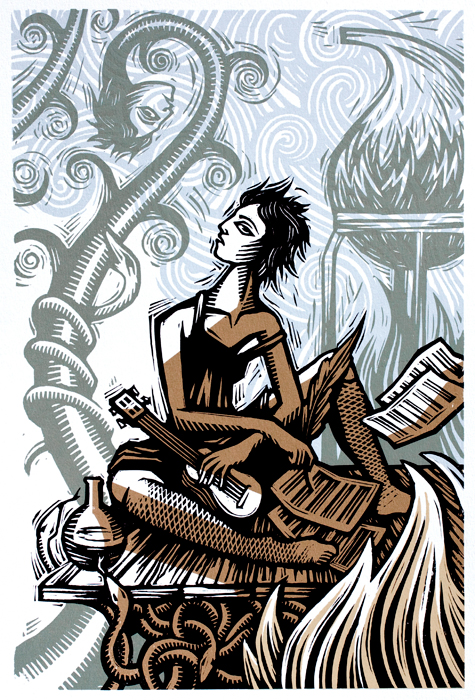
A few months ago, the awesome and amazing musician/performer/poet Amanda Palmer (formerly of the Dresden Dolls, now performing solo with a new band The Grand Theft Orchestra) reached out to me to create some art for her upcoming book and tour. Her plan was to get a bunch of artists to create visual interpretations of her new songs and herself. The results were going to be compiled in a book that would be coming out around the same time as her new album. In addition to this, she was going to do a set of acoustic performances/gallery shows where the art would be exhibited. Being a fan of such artistic collaborations and AFP, I jumped to the task! As a result, two pieces were created – one based on the song (more on that in the future post) and one depicting Amanda:

AFP

So as far as the process goes… Bellow are some images of Amanda that provide just a tiny glimpse into her personality. Her live shows are incredibly theatrical and electrifying, going way beyond being defined by any one genre. The lyrics are smart, sharp, funny and poignant.

AFP

Bellow is the initial sketch that I have actually done a year ago while working on some t-shirt designs for Amanda. Since that time, I’ve gotten to know and understand her art and music a little better. While coming up with ideas, some old medieval alchemy images started to come to mind (like the one on the right). The final result turned out to be a hybrid of those two approaches.

alchemy

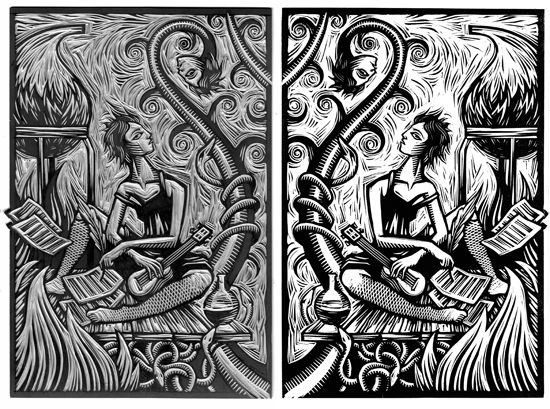
The initial image was a linoleum cut (on the left), actual print (on the right).

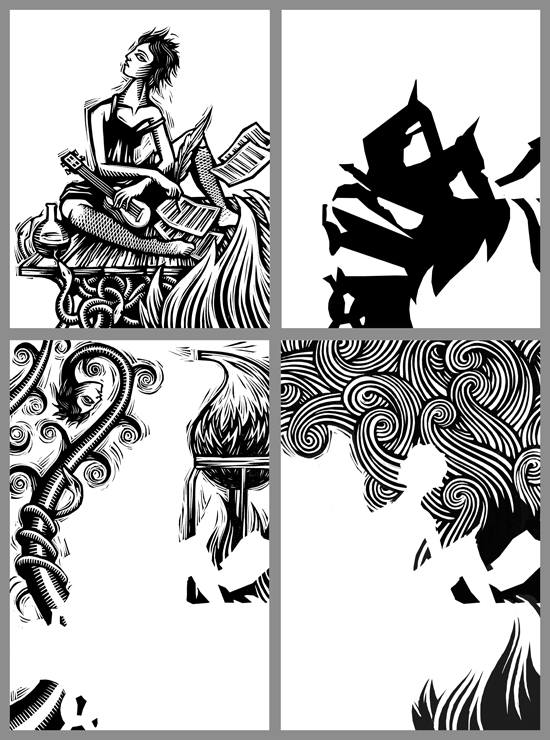
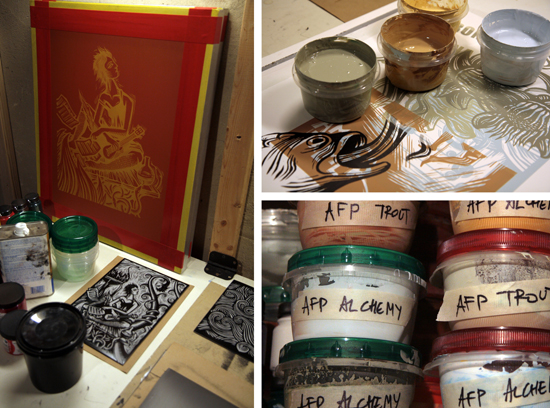
LinocutAfter scanning the print into Photoshop, I’ve started to think of how this could appear in color. I broke the image down to three colors and also added a background layer of the smoke in the background. Bellow are the four files I’ve used to create the screens from, initially deciding that one is going to be black, the other brown, next one dark green and the last one light blue. Some of those would overlap when printed.

AFP

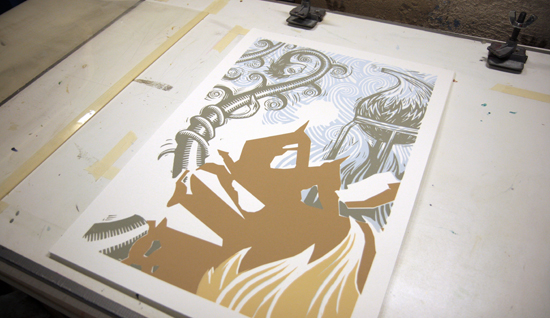
And here’s how it all started to come together when the screens were all done and the printing process had begun.

AFP progress

As always, the plan was to crank this out in one night. As it happens, it took two whole nights just to get all the inks mixed and figured out. Of course there were little surprises along the way. This time after spending a few hours coming up with a perfect color combination I had to throw the inks out and start from scratch, simply because those particular inks would not cooperate with the paper.

silkscreen process

Working my way from background to foreground, light to dark. The final pass was the black layer.

silkscreen

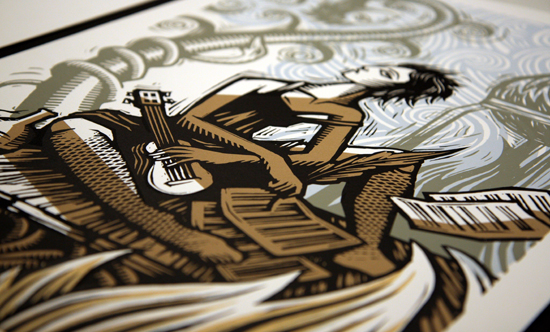
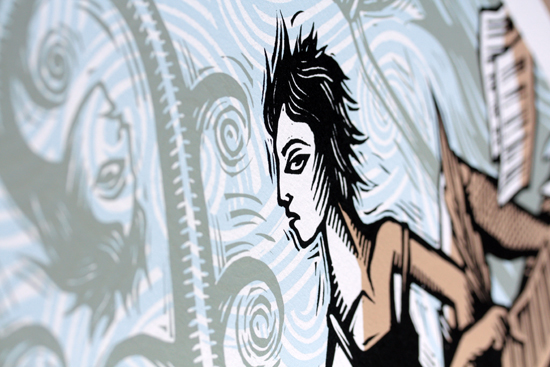
And here are a few detail shots.

Vladimir ZImakov

Vladimir Zimakov

Vladimir Zimakov silkscreen

This is the print alongside the one I’ve made for one of the songs.

AFP silkscreen

Since sending those out to Amanda’s headquarters they have traveled to London, Berlin, Paris, San Francisco, Los Angeles and Boston. They are also now available at Etsy for sale. Bellow is a picture of Amanda in front of them at one of the gallery show events (I believe that one is from London). More on those events, shows, the book those will appear in and the art talk that Amanda and I did in San Francisco a bit later.

The Sound of a Migrane

In the summer of 2011 I have met Mihail Pogarsky, a man who is hugely involved in the Russian Artist Book art scene. He organizes annual Artist Book Fairs in Moscow, publishes a magazine on the subject, initiates a variety of international book projects and creates beautiful books himself. Over coffee we’ve discussed many aspects of what we do and what’s happening in the book art world in Russia and USA. Several months later I have received an email from him asking me if I would be interested in participating in a project that he is curating entitled Music of the Book. 12 artists from Russia and 12 from Germany and Austria were involved. This was designed to be a multidisciplinary project between Artist’s Book and multimedia. The books that were to be created would be part of an international traveling exhibition. Bellow is my entry.

Sound of Migrane book

The brief was to create a one or two spread book that will reflect visually a certain piece of music, sound, noise, etc. I initially wanted to take a piece of music for the interpretation (Gavin Bryar’s Jesus Blood Never Failed Me Yet, for an example). Then an idea came to use a sound that is not a sound at all. To visualize something that we all hear sometimes inside of us, but that can not be projected or recorded. So here are the process stages of The Sound of a Migraine:

I wanted to use the image of the rats scraping away at something. I “borrowed” the rat linocut image from a piece that I have done last year for a story by Adgar Allan Poe. The choosing of the background followed.

This was going to be a collage. I wanted to actually cut out the “pounding headache noise”.

Zimakov collage

After a while, the studio desk was filled with x-acto knives, ink, prints, chipboard and paper.

Zimakov studio

In addition to the cut-out red “sounds”, I made a rubber stamp that would be stamped in black over the final inside spread.

stamp

The cover image would serve as an introduction to what’s inside. Prints and cutouts were mounted onto a chipboard.

book cover

This book was an edition of two. Both copies were sent to Mihail in Russia. So far they have been exhibited at the Central House for the Artist in Moscow and the Tretyakov State Gallery, among other places. Germany is next,  so you might catch them floating around Europe at some point! Check out more about the concept and see other artists’ submissions here.